
Best Medicine for Joint Pain: What Actually Helps
Approved By Dr Sohail Magoon
Finding the best medicine for joint pain starts with understanding a simple fact: no single tablet works for every kind of joint pain, because arthritis, gout, a ligament injury, and post-viral aches all respond differently to medication. What works well for swelling from arthritis may do very little for a torn ligament, so the right choice depends on what’s actually causing the pain in the first place — not on which product happens to be marketed the loudest.
This guide breaks down the medicine categories people commonly reach for, how to match medicine to where the pain is and who’s taking it, and where medication alone reaches its limit — which matters most for anyone whose pain and stiffness keep coming back no matter what they take.
Over-the-Counter Options People Try First
For mild to moderate joint pain, most people start with what’s available at any pharmacy without a prescription. Knowing how these differ helps you pick the right one instead of grabbing whatever’s on the shelf.
NSAIDs (Non-Steroidal Anti-Inflammatory Drugs)
Ibuprofen, diclofenac, and naproxen are the most widely used over-the-counter choices for joint pain because they reduce both pain and inflammation at the source. They work well for arthritis flare-ups, mild sprains, and general aches and stiffness, but regular long-term use can affect the stomach and kidneys, so they’re meant for short-term relief rather than a daily long-term solution. Anyone with a history of ulcers, kidney issues, or heart disease should check with a doctor before using NSAIDs regularly, since these are exactly the groups most likely to experience side effects.
Paracetamol (Acetaminophen)
Paracetamol manages pain without addressing inflammation directly. It’s gentler on the stomach than NSAIDs, which makes it a reasonable option for people who can’t tolerate anti-inflammatories, though it won’t do much for a joint that’s visibly swollen. It’s often combined with an NSAID under medical guidance for pain that isn’t fully controlled by either drug alone.
Topical Gels and Creams
Diclofenac gel and other topical anti-inflammatory creams are often the best medicine for joint pain in a single, easily accessible area — a knee, elbow, or knuckle — since the medication acts locally with less impact on the rest of the body compared to tablets. This makes topical treatment a sensible first choice for older adults or anyone who needs to limit oral medication use, and it’s a common daily option for milder, ongoing stiffness rather than an acute flare.
Best Medicine for Joint Pain and Swelling
When swelling is the main issue — a hallmark of arthritis and gout flares — oral NSAIDs typically outperform paracetamol because they directly target the inflammatory process rather than just blunting pain signals. For a gout attack specifically, doctors often prescribe short courses of stronger anti-inflammatory medication or colchicine, since regular NSAIDs may not be enough for the intensity of a gout flare. Cortisone injections directly into the joint are another option doctors use for concentrated, short-term relief of swelling that hasn’t responded to oral medication, particularly for a single problem joint like a knee or shoulder.
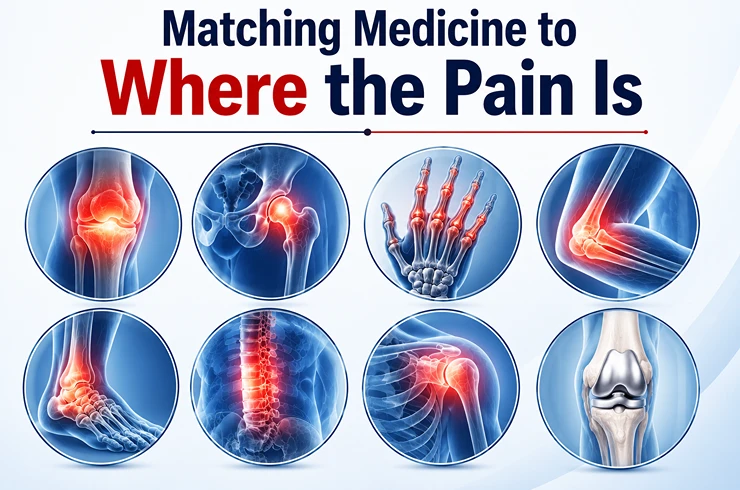
Matching Medicine to Where the Pain Is
Joint pain doesn’t behave the same way everywhere in the body, and the best approach shifts depending on location.
Supplements Commonly Used for Joint Health
Supplements don’t work as fast as painkillers, but many people use them for longer-term joint support alongside — not instead of — proper treatment.
Supplement | What It’s Used For | Notes |
|---|---|---|
Glucosamine & Chondroitin | Cartilage support in osteoarthritis | Effects build gradually over weeks |
Vitamin D | Bone and muscle health | Especially relevant if aching is widespread, not localized |
Omega-3 fatty acids | Mild anti-inflammatory support | Found in fish oil, flaxseed (a vegan alternative) |
Turmeric (curcumin) | Natural anti-inflammatory compound | Often used in ayurvedic and herbal approaches |
Collagen peptides | Joint tissue support | Popular for general joint health maintenance |
Magnesium | Muscle and nerve function | Relevant if joint pain overlaps with muscle cramping |
If your joints ache without swelling and a blood test hasn’t ruled out a specific cause, checking vitamin D levels is worth doing before assuming supplements alone will solve it. Supplements are also where quality varies enormously between brands, so consistency and a reputable source matter more than the price on the label.
Joint Supplements for Different Groups
Herbal and Ayurvedic Approaches
Joint pain herbal treatment is a common search, particularly across South Asia, where turmeric, ginger, and Boswellia serrata (shallaki) have long been used for their anti-inflammatory properties. These can offer mild, gradual relief for everyday stiffness, but they’re not a substitute for medical evaluation when pain is severe, one-sided, or accompanied by swelling, fever, or joint deformity — signs that point toward a condition needing proper diagnosis rather than home remedies. Herbal approaches also interact with certain prescription medications, so it’s worth mentioning any herbal supplements you’re taking regularly when you see a doctor.

Medicine After a Viral Illness
Joint pain after chikungunya or another viral infection is extremely common and can linger for weeks or even months after the fever itself has resolved. In this situation, NSAIDs are generally the first-line medicine for joint pain, since the discomfort is driven by lingering inflammation from the immune response rather than joint damage itself. If the pain persists well beyond the typical recovery window — generally more than a few months — it’s worth having it evaluated rather than continuing painkillers indefinitely, since prolonged post-viral joint pain can occasionally overlap with an emerging autoimmune condition.
Prescription Options for More Severe or Autoimmune Cases
When over-the-counter medicine isn’t enough — often the case with rheumatoid arthritis, lupus, or advanced osteoarthritis — doctors may prescribe stronger anti-inflammatory medication, disease-modifying drugs for autoimmune arthritis, or corticosteroid injections directly into the affected joint. Lupus-related and rheumatoid joint pain in particular is usually managed with disease-modifying medication rather than standard painkillers, since the goal is to control the underlying immune response, not just mask discomfort. These prescriptions require proper diagnosis first, since a disease-modifying drug for autoimmune arthritis works on a completely different mechanism than a painkiller for a strained knee. Self-adjusting prescription doses or mixing multiple anti-inflammatories without medical guidance is one of the more common mistakes people make, and it raises the risk of side effects without necessarily improving pain control.
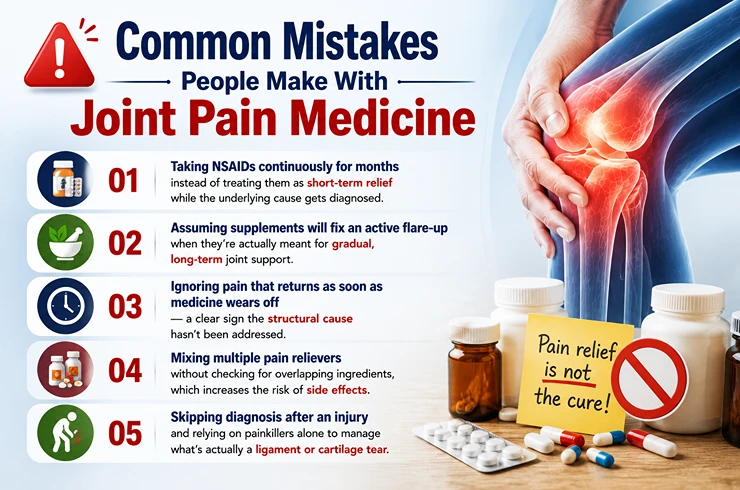
Common Mistakes People Make With Joint Pain Medicine
A few patterns show up repeatedly in people who don’t get lasting relief:
- Taking NSAIDs continuously for months instead of treating them as short-term relief while the underlying cause gets diagnosed.
- Assuming supplements will fix an active flare-up when they’re actually meant for gradual, long-term joint support.
- Ignoring pain that returns as soon as medicine wears off — a clear sign the structural cause hasn’t been addressed.
- Mixing multiple pain relievers without checking for overlapping ingredients, which increases the risk of side effects.
- Skipping diagnosis after an injury and relying on painkillers alone to manage what’s actually a ligament or cartilage tear.
Why Medicine Alone Doesn’t Always Solve the Problem
Painkillers and anti-inflammatories manage symptoms, but they don’t repair a torn ligament, rebuild worn cartilage, or fix joint instability. If your joint pain keeps returning every time a course of medicine wears off, that’s usually a sign the underlying structural damage — not just inflammation — hasn’t actually been addressed, and it’s exactly why so many people go looking for the best treatment for joint pain without surgery instead of another prescription refill.
This is where non-surgical regenerative treatment becomes relevant. At Sohail OrthoCure, with clinics in Islamabad and Multan, the approach starts with identifying what’s structurally causing the pain, then treating it directly:
Prolotherapy
Prolotherapy in Pakistan is designed to support healing in weakened ligaments and tendons around a joint. It may be useful when joint instability or tissue weakness contributes to ongoing pain. The goal is to improve structural support and function rather than simply masking symptoms.
Platelet-Rich Plasma (PRP)
PRP therapy uses concentrated platelets prepared from your own blood. These platelets contain growth factors that may support the body’s natural tissue-healing process. It may be considered for selected patients with joint, tendon, or cartilage-related problems.
Mesenchymal Stem Cell Therapy
Mesenchymal stem cell therapy is being explored for its potential regenerative effects on damaged tissues. It may be considered for selected patients with more advanced joint or cartilage problems. Treatment suitability depends on the condition, severity of damage, and individual assessment.
Ozone Therapy
Ozone therapy Clinic may help manage inflammation associated with certain joint conditions. It is used as a minimally invasive approach aimed at improving comfort and joint function. Your doctor can determine whether it is appropriate based on the underlying cause of your pain.
Neural Prolotherapy
Neural prolotherapy focuses on irritated superficial nerves that may contribute to persistent joint discomfort. It may help reduce abnormal pain signaling and support local tissue recovery. This approach can be considered when nerve-related pain continues despite conventional treatment.
Cortisone injections
Cortisone injections can provide targeted relief by reducing inflammation around a painful joint. They may help decrease swelling and discomfort, particularly during painful flare-ups. These injections should be used selectively and administered under appropriate medical supervision.
None of these replace medicine outright — they’re aimed at the structural cause that medicine can’t reach on its own, which is why they’re often used once it’s clear that pills and creams are only offering short-term relief.
When to Stop Relying on Medicine and Get Evaluated
If you’ve been taking joint pain medicine regularly for more than a few weeks without lasting improvement, or if the pain returns as soon as the medicine wears off, that’s a signal worth acting on rather than ignoring. The same applies to swelling that doesn’t go down, joint pain and stiffness that limits movement, or pain following an injury that never fully resolved. A proper diagnostic evaluation — the kind offered at Sohail OrthoCure’s Islamabad and Multan clinics — identifies whether you’re dealing with inflammation, ligament damage, cartilage wear, or something else entirely, so treatment actually targets the right problem instead of another round of trial-and-error medication. You can book a consultation via WhatsApp at +92 308 7777614 or through their contact page.
Frequently Asked Questions
Final Thoughts
The best medicine for joint pain depends entirely on what’s causing it — inflammation, injury, deficiency, or structural wear all call for different approaches, and no single tablet covers all of them. Medicine can control symptoms in the short term, but when the pain and stiffness keep returning, it’s usually a sign that the root cause needs proper diagnosis and targeted, non-surgical treatment rather than another round of painkillers.
Book Appointment
With Dr. Sohail Magoon